Launch offer — valid today only

📄 Digital book in PDF · read it on your phone or print it

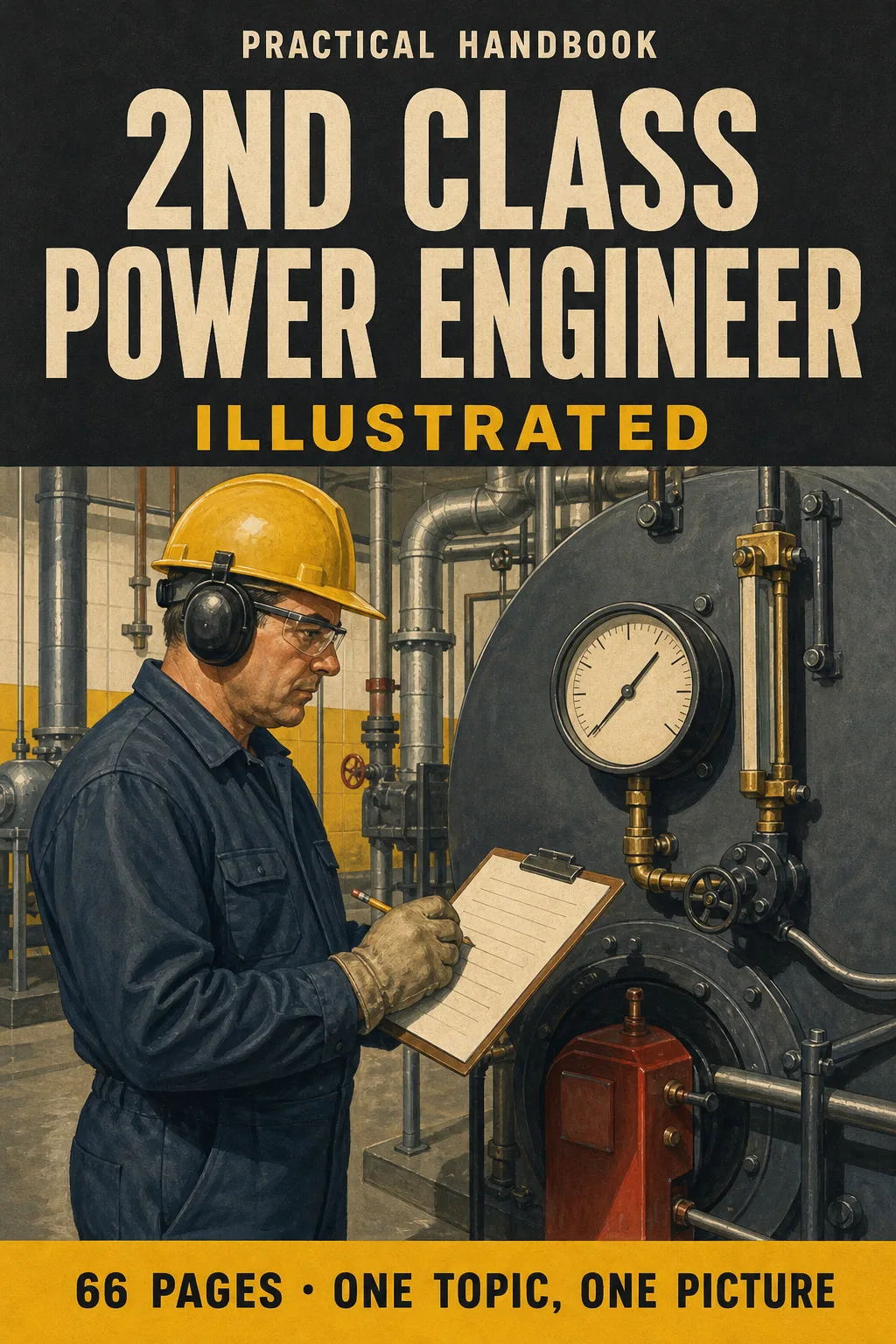
The 2nd Class Power Engineer Exam, Illustrated: Steam Tables, Boilers and Every Calculation in the Same 4 Steps One Topic on Every Page

Boilers and fittings, safety valves, steam tables, combustion, turbines, the Rankine cycle, boiler water treatment and plant safety. Every topic has its own page: the drawing first, then what you need to remember. 66 illustrated pages.

GET 2ND CLASS POWER ENGINEER ILLUSTRATED

🔒 Secure checkout · PDF by email · 30-day guarantee

Every topic, its own pageEvery boiler, cycle and calculation drawn, with the explanation beside it
66 illustrated pages9 parts, from the exam and the method to your last-week review
Up-to-date sourcesThe standardized 2nd Class syllabus, CSA B51 and provincial requirements (ABSA, TSSA, TSASK, Technical Safety BC)
PDF by emailFormat

Look Inside the Book

Every page has a big drawing and a box with the numbers, formulas and steps you need to know:

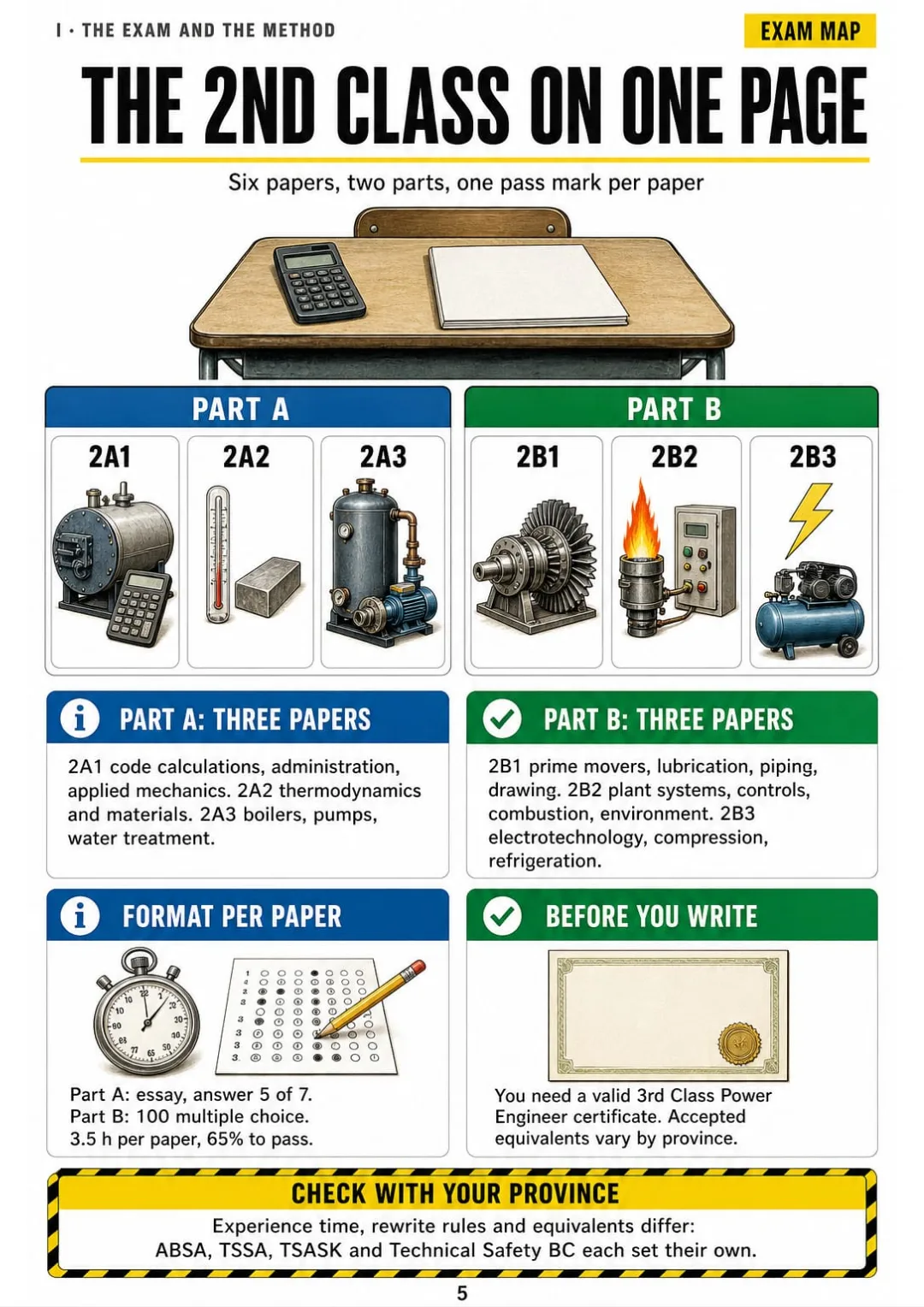
6 papers · Part B: 100 multiple-choice questions · 3.5 h each · 65% on each
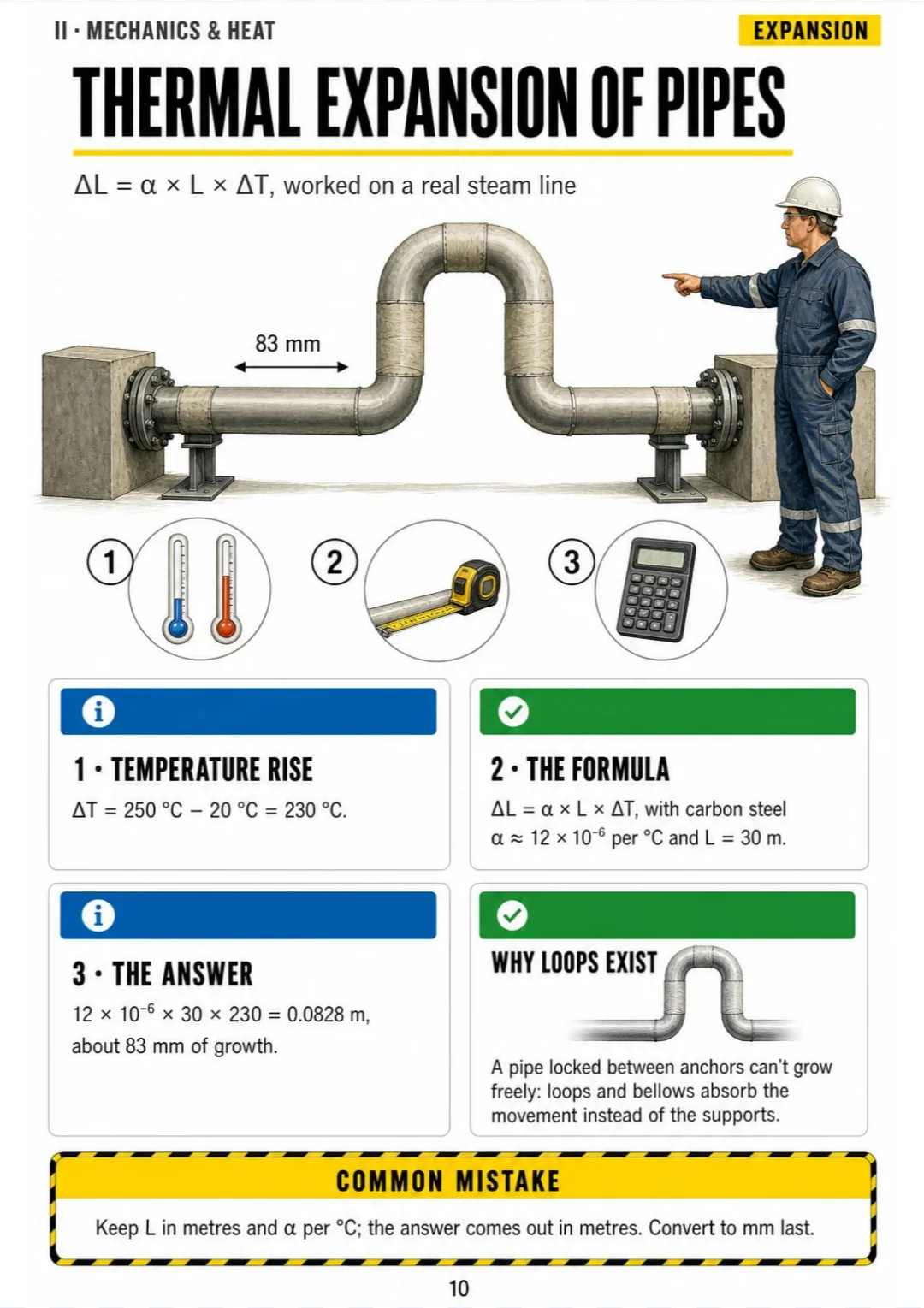
ΔL = α × L × ΔT: 30 m of steel from 20 °C to 250 °C grows about 83 mm.
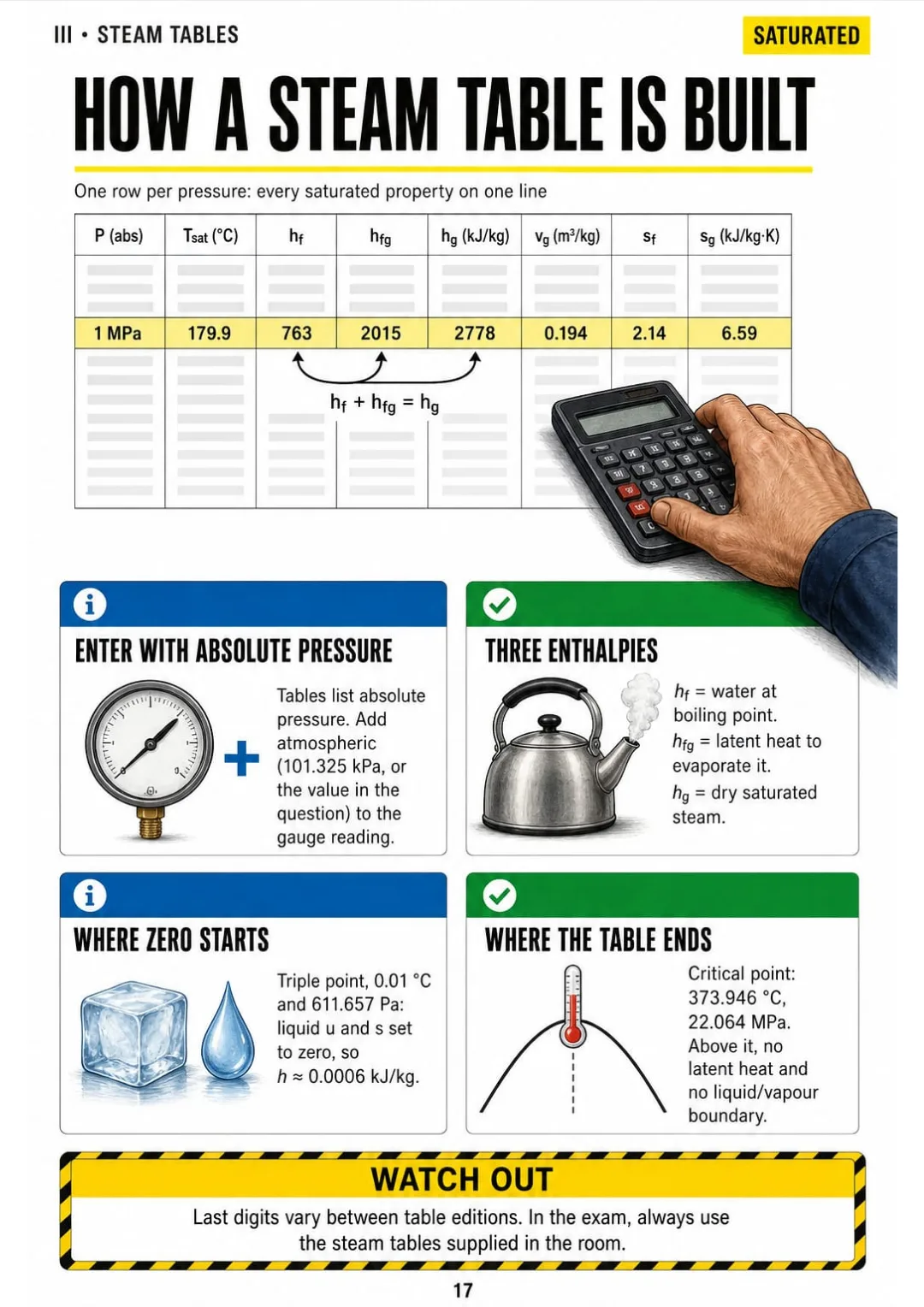
At 1 MPa(abs): Tsat ≈ 179.9 °C, hf ≈ 763, hfg ≈ 2015, hg ≈ 2778 kJ/kg
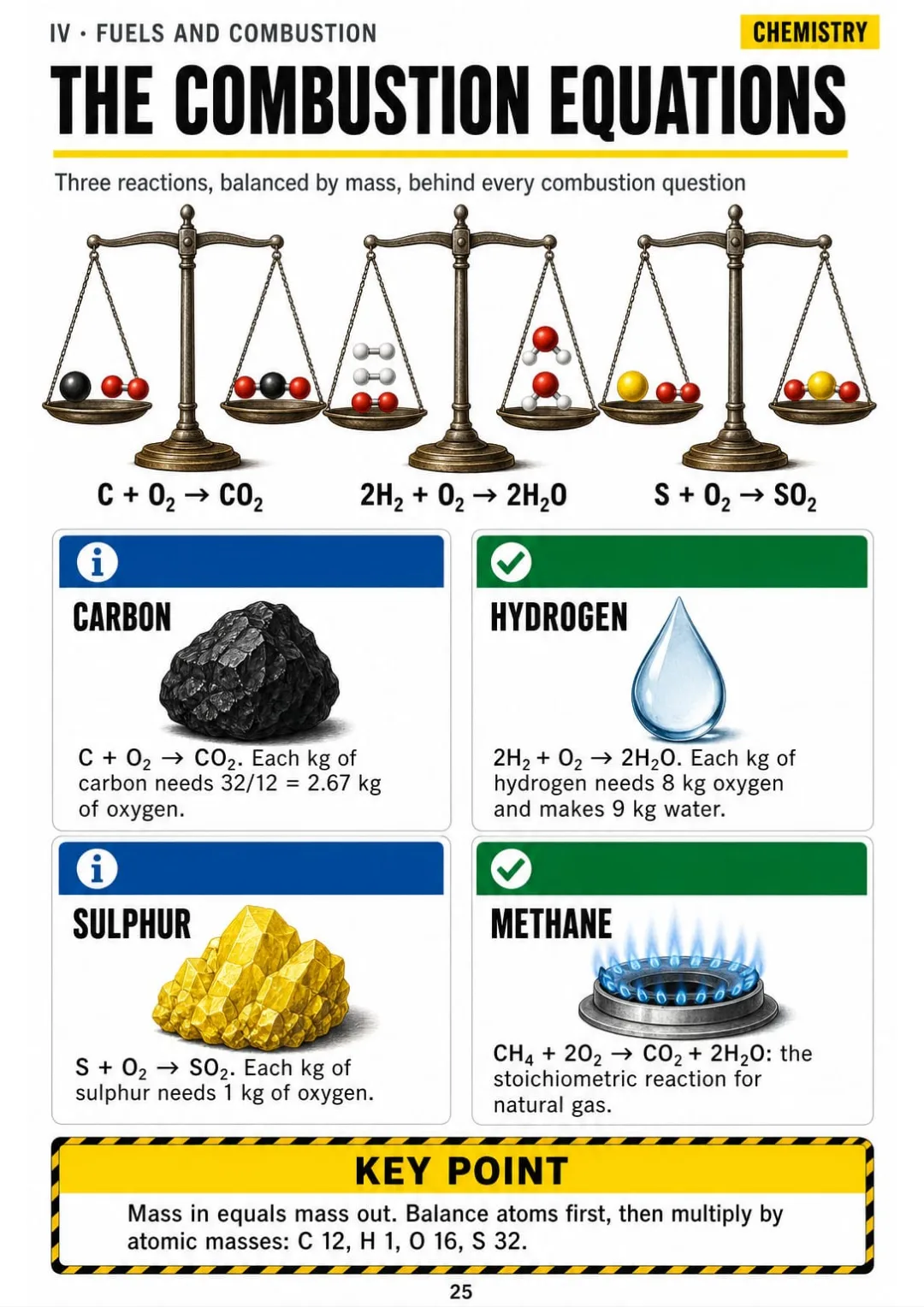
12 kg C + 32 kg O₂ → 44 kg CO₂: the three reactions on a balance
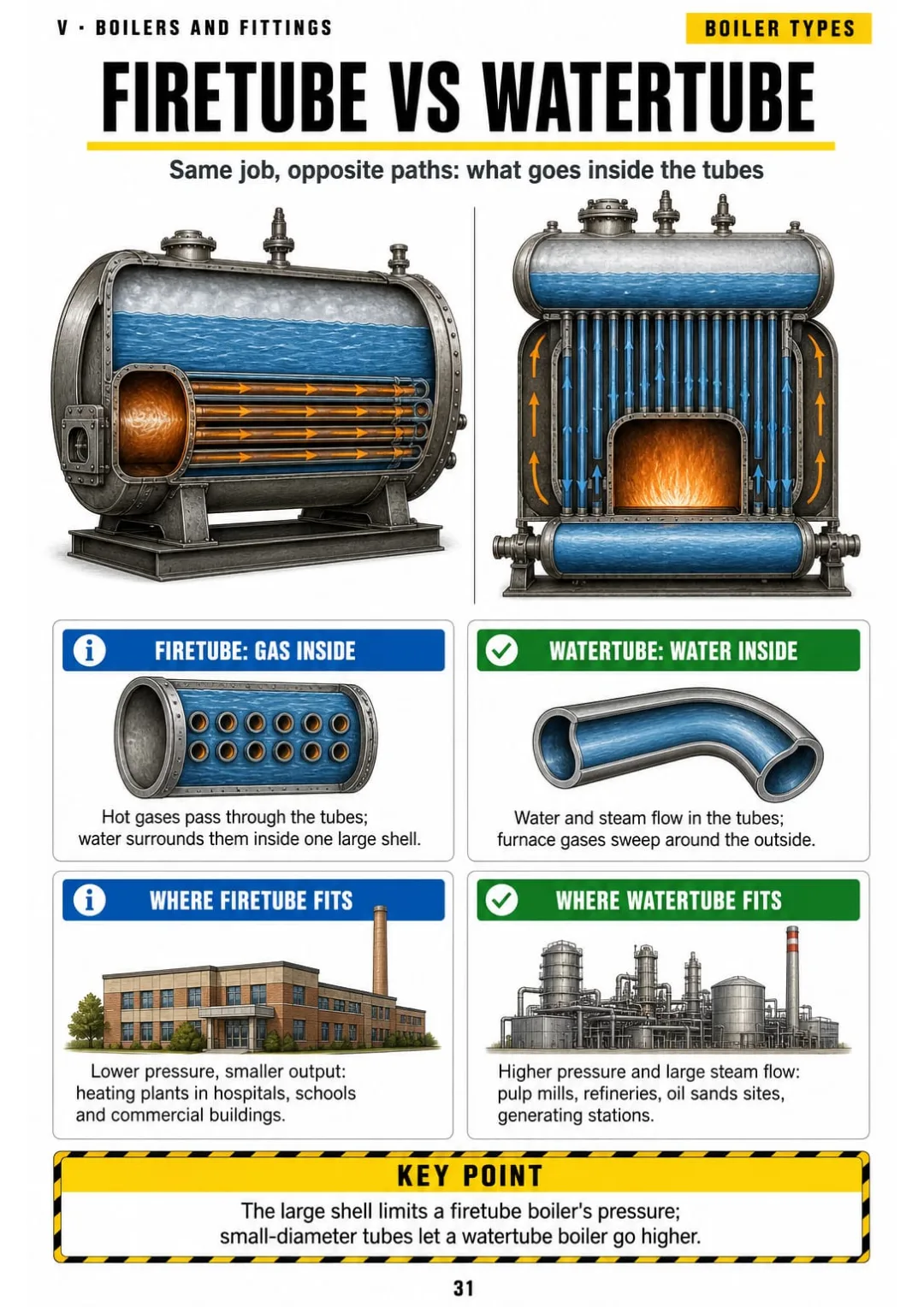
Firetube: gas in the tubes. Watertube: water in the tubes, built for higher pressure.
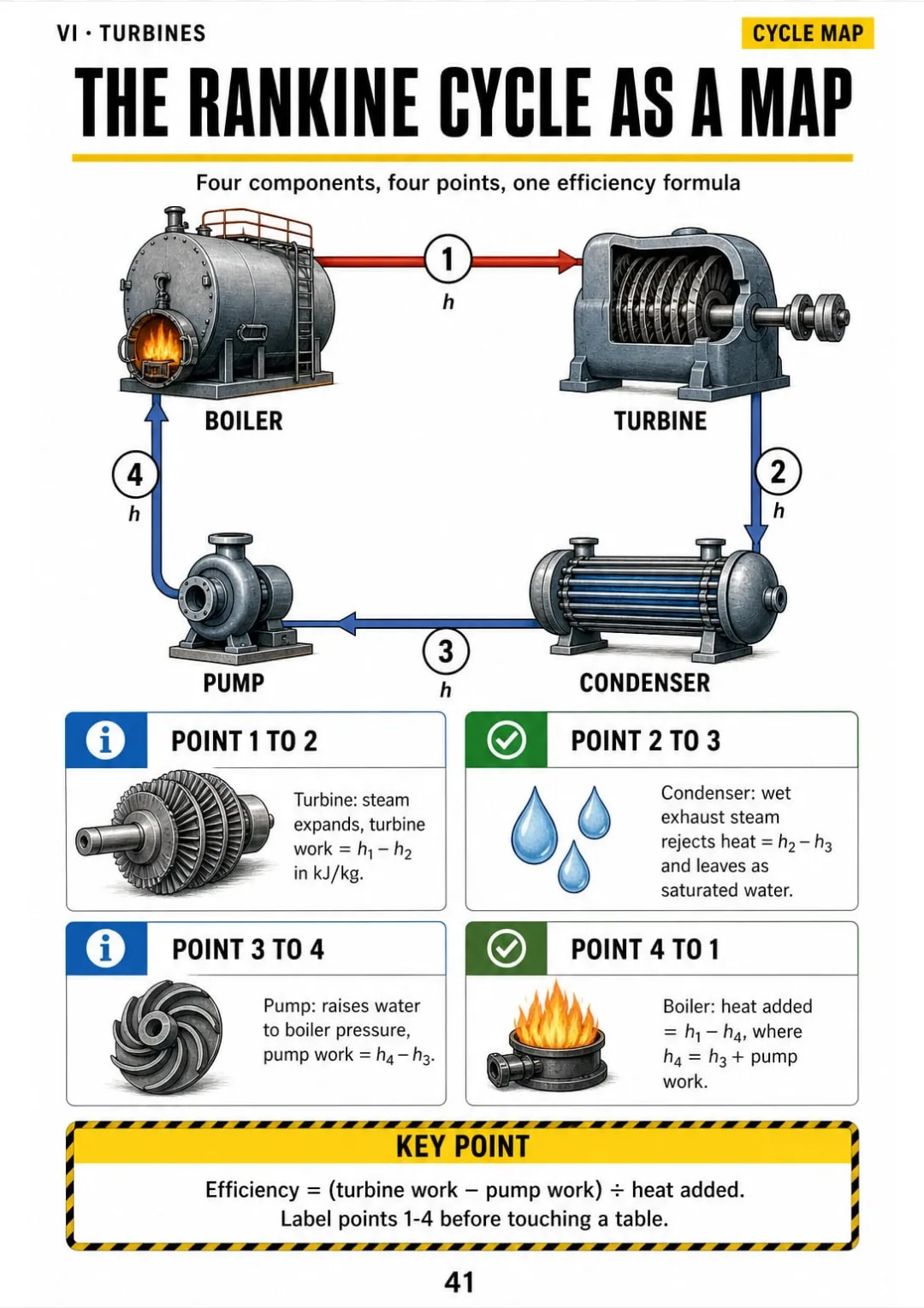
Pump, boiler, turbine, condenser: points 1-4 and efficiency = (turbine work − pump work) ÷ heat added
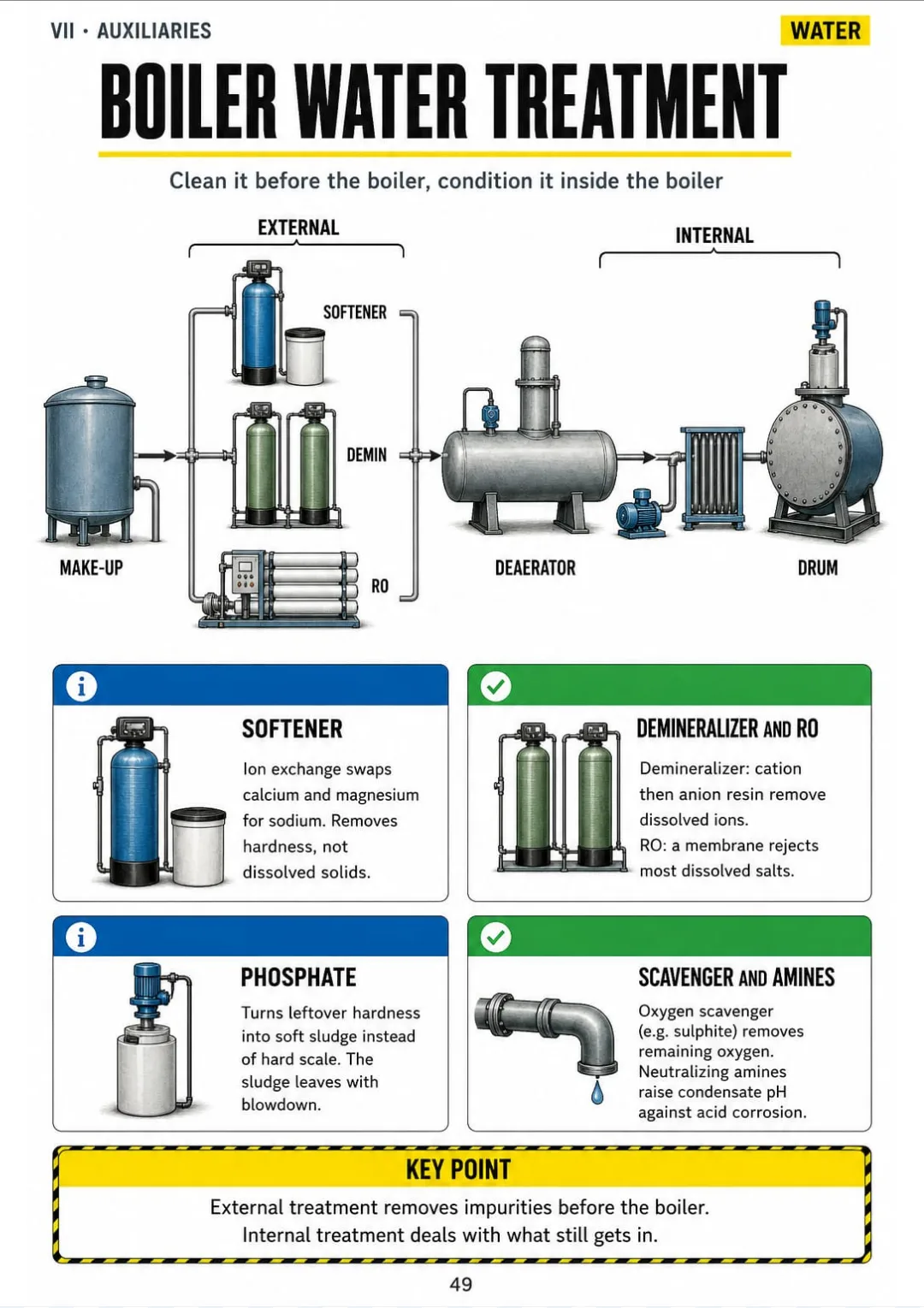
Softener, demineralizer, RO, phosphate, scavenger and amines on one water path
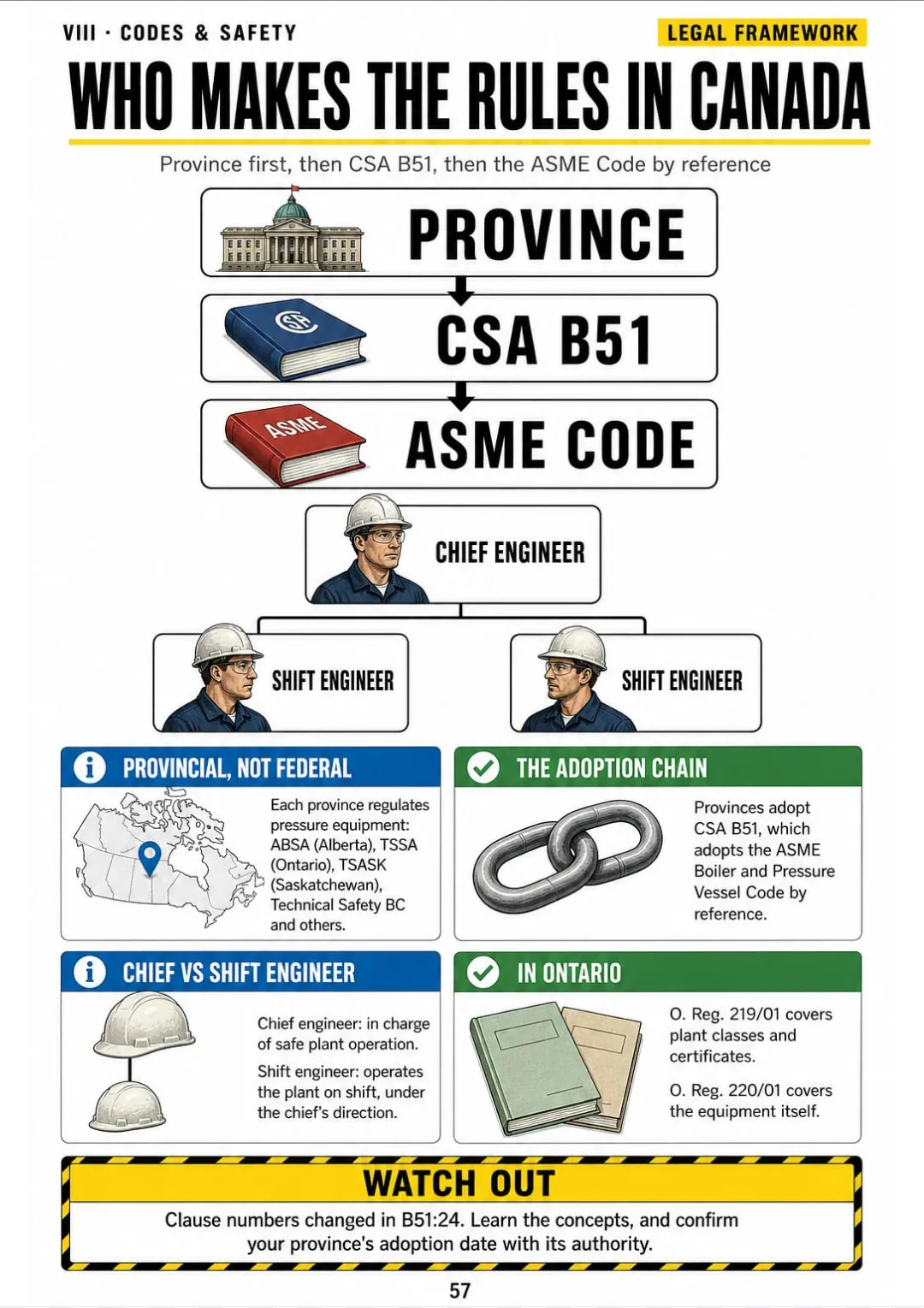
Province → CSA B51 → ASME Code: who regulates your boiler plant, drawn as one chain

Swipe to see more →

These are real pages from the book. The table of contents is the full one: 9 parts and 62 topics.

The Problem Isn't You. It's How It Was Explained to You.

You're in the control room between rounds, the steam tables open at 1 MPa, and the columns blur into one block of numbers.

Which one is hf? Where does hfg come from, and why is hg bigger? The course text explains it in long paragraphs, and after a twelve-hour shift none of it holds.

At 1 MPa(abs): Tsat ≈ 179.9 °C, hf ≈ 763, hfg ≈ 2015, hg ≈ 2778 kJ/kg

In the book, that same table is one page: the absolute pressure, the saturation temperature at about 179.9 °C, then hf, hfg and hg drawn as steps, with hf + hfg = hg in a box.

Drum stress, the combustion equations, firetube vs watertube, the Rankine cycle and boiler water treatment each get their own page too.

You see why the numbers fit together, and you work the next problem without going back to the course text.

COMPARE FOR YOURSELF

The Same Topic, Two Ways to Study It

THIS
  • The course text: line after line
  • Hoop and longitudinal stress explained only in words
  • You walk into the exam with doubts
A cylindrical shell subjected to internal pressure develops two principal membrane stresses. The circumferential, or hoop, stress acts tangentially to the shell and is obtained by equating the bursting force on a longitudinal section, P × D × L, to the resisting force of the two wall sections, 2 × t × L × σ, which gives σ = PD/2t. The longitudinal stress, derived from the pressure force acting on the end closure, is half of this value, PD/4t; consequently, the longitudinal joint governs the required plate thickness.
FOR THIS
  • Drum stress in one drawing
  • The formulas and numbers in a box
  • You see it and you get it
ΔL = α × L × ΔT: 30 m of steel from 20 °C to 250 °C grows about 83 mm.
CONTENTS

Take a Look at the 9 Parts and 62 Topics

The exam and the method, applied mechanics and heat, steam tables, fuels and combustion, boilers and fittings, turbines and the Rankine cycle, plant auxiliaries, codes and safety, and exam-day review: 66 pages, all illustrated.

IThe exam and the method · pp. 5-8
  1. What the 2nd Class covers
  2. The 4-step method: data, sketch, calculate, conclude
  3. SI units you can't afford to mix up
  4. Gauge vs absolute pressure
IIApplied mechanics and heat basics · pp. 9-16
  1. Stress in a boiler drum: hoop vs longitudinal
  2. Thermal expansion of pipes and tubes
  3. Work, power and efficiency
  4. Sensible heat vs latent heat
  5. Gas laws in one page
  6. Heat transfer: conduction, convection, radiation
  7. Heat exchangers and LMTD
  8. Materials and tube failure
IIISteam tables, step by step · pp. 17-24
  1. How a steam table is built
  2. Wet steam and dryness fraction
  3. Superheated steam tables
  4. Linear interpolation without mistakes
  5. Heat added in a boiler
  6. Throttling and separating calorimeters
  7. Entropy and the T-s diagram
  8. The Mollier (h-s) chart
IVFuels and combustion · pp. 25-30
  1. The combustion equations
  2. Theoretical air for a fuel
  3. Excess air and flue gas analysis
  4. Higher vs lower heating value
  5. Natural gas, oil and solid fuel firing
  6. Stack losses and draft
VBoilers and fittings · pp. 31-40
  1. Firetube vs watertube
  2. Natural circulation and the drum
  3. Superheaters, reheaters and economizers
  4. Attemperators and steam temperature control
  5. Safety valves: how they pop and reseat
  6. Safety valve capacity and testing
  7. Water column, gauge glass and low-water cutoff
  8. Blowdown: continuous vs bottom
  9. Feedwater control: single, two and three element
  10. Boiler start-up and shutdown sequence
VITurbines and the Rankine cycle · pp. 41-48
  1. The Rankine cycle as a map
  2. Worked Rankine efficiency
  3. Reheat and regenerative cycles
  4. Impulse vs reaction turbines
  5. Velocity diagrams
  6. Steam rate and turbine output
  7. Condensers and vacuum
  8. Turbine protection and trips
VIIPlant auxiliaries and systems · pp. 49-56
  1. Boiler water treatment
  2. Deaerators
  3. Centrifugal pumps and NPSH
  4. Air compressors
  5. Refrigeration cycle
  6. Generators and three-phase power
  7. Instrumentation and control loops
  8. Lubrication and bearings
VIIICodes, safety and operation · pp. 57-62
  1. The pressure equipment legal framework in Canada
  2. Boiler inspection and repairs
  3. Lockout and confined space entry
  4. Furnace explosions and purge
  5. Low water: what to do and what never to do
  6. Water hammer and steam line warm-up
IXReview and exam day · pp. 63-66
  1. The formula sheet on one page
  2. The most common calculation slip-ups
  3. How to plan a long-answer question
  4. Your last-week review checklist

One Page, One Topic, All Clear

Think of it this way:

You're on a quiet night shift between rounds, and the low-water question you got wrong last week is still bugging you.

You open the book at that page and see the water column, the gauge glass and the low-water cutoff drawn on the drum, with what each one does, in order, right beside them.

Firetube: gas in the tubes. Watertube: water in the tubes, built for higher pressure.

Same with safety valves, the Rankine cycle, flue gas analysis, NPSH and water hammer: each one on its own page.

2nd Class Power Engineer Illustrated is 9 parts and 62 topics, all drawn, and at the end, the formula sheet, the most common calculation slip-ups and a last-week checklist.

What you see drawn, you don't have to memorize.

What's Inside 2nd Class Power Engineer Illustrated:

Ipp. 5-8

The exam and the method

What the 2nd Class covers, the 4-step method, the SI units you can't mix up and gauge vs absolute pressure.

IIpp. 9-16

Applied mechanics and heat basics

Hoop and longitudinal stress, thermal expansion, work and power, sensible vs latent heat, gas laws, heat transfer, LMTD and tube failure.

IIIpp. 17-24

Steam tables, step by step

How a steam table is built, dryness fraction, superheated tables, interpolation, heat added, calorimeters, entropy and the Mollier chart.

IVpp. 25-30

Fuels and combustion

The combustion equations, theoretical and excess air, flue gas analysis, heating values, firing systems, stack losses and draft.

Vpp. 31-40

Boilers and fittings

Firetube vs watertube, circulation and the drum, superheaters and economizers, safety valves, gauge glass and low-water cutoff, blowdown, feedwater control and start-up.

VIpp. 41-48

Turbines and the Rankine cycle

The Rankine cycle as a map, worked efficiency, reheat and regeneration, impulse vs reaction, velocity diagrams, steam rate, condensers and trips.

VIIpp. 49-56

Plant auxiliaries and systems

Boiler water treatment, deaerators, pumps and NPSH, air compressors, refrigeration, generators, control loops and lubrication.

VIIIpp. 57-62

Codes, safety and operation

Who regulates pressure equipment in Canada, inspection and repairs, lockout and confined space, furnace purge, low water and water hammer.

IXpp. 63-66

Review and exam day

The formula sheet, the most common calculation slip-ups, how to plan a long-answer question and a last-week checklist.

At the end of the book: The formula sheet on one page, the most common calculation slip-ups, long-answer planning and a last-week checklist.
Plus: 2 Free Books

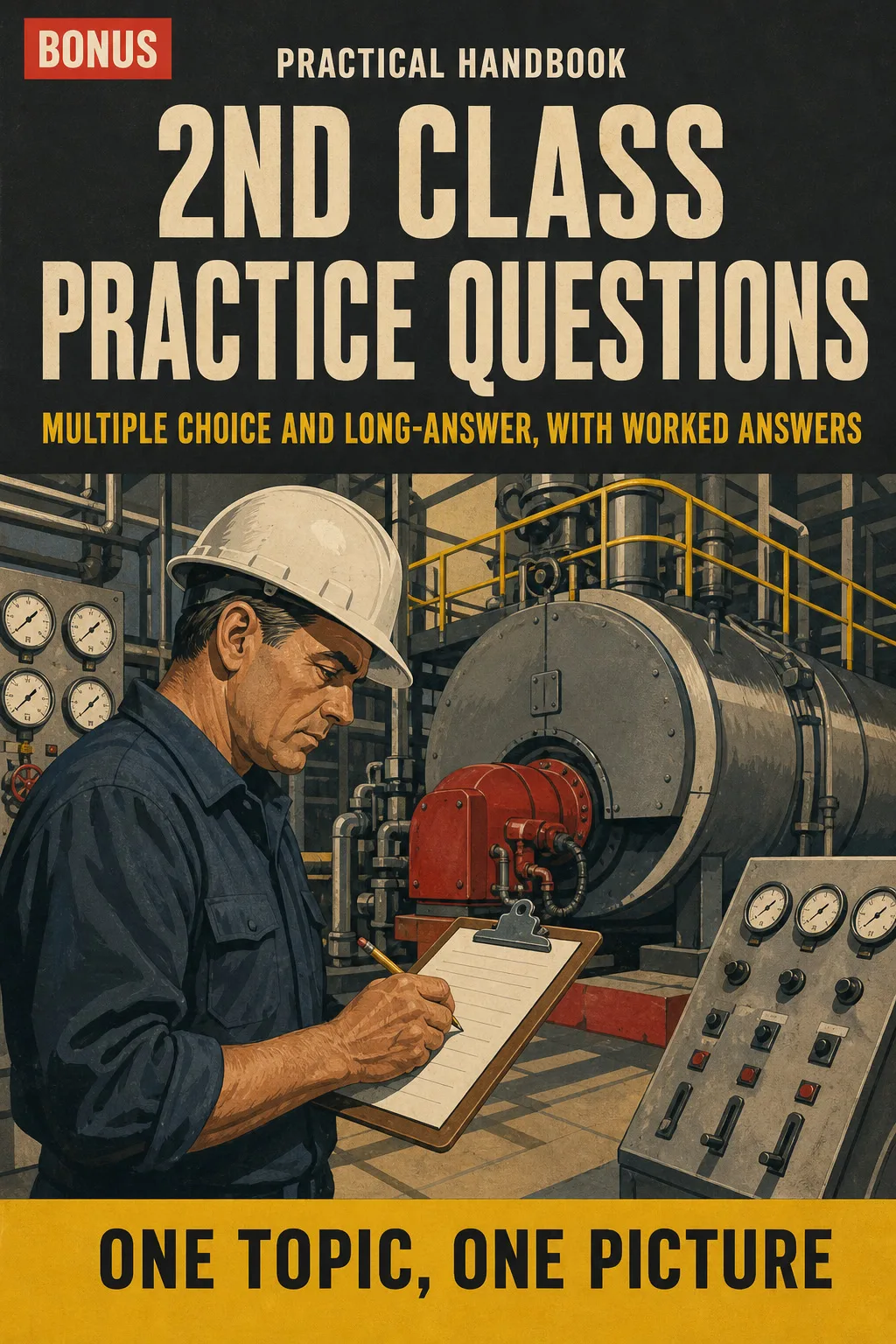
2nd Class Practice Questions: Multiple Choice and Long-Answer, with Worked Answers

BONUS 1: «2nd Class Practice Questions: Multiple Choice and Long-Answer, with Worked Answers»

Value on its own: US$ 17.90

Test yourself in exam style on every big topic and check each answer step by step, so you know exactly where you still go blank.

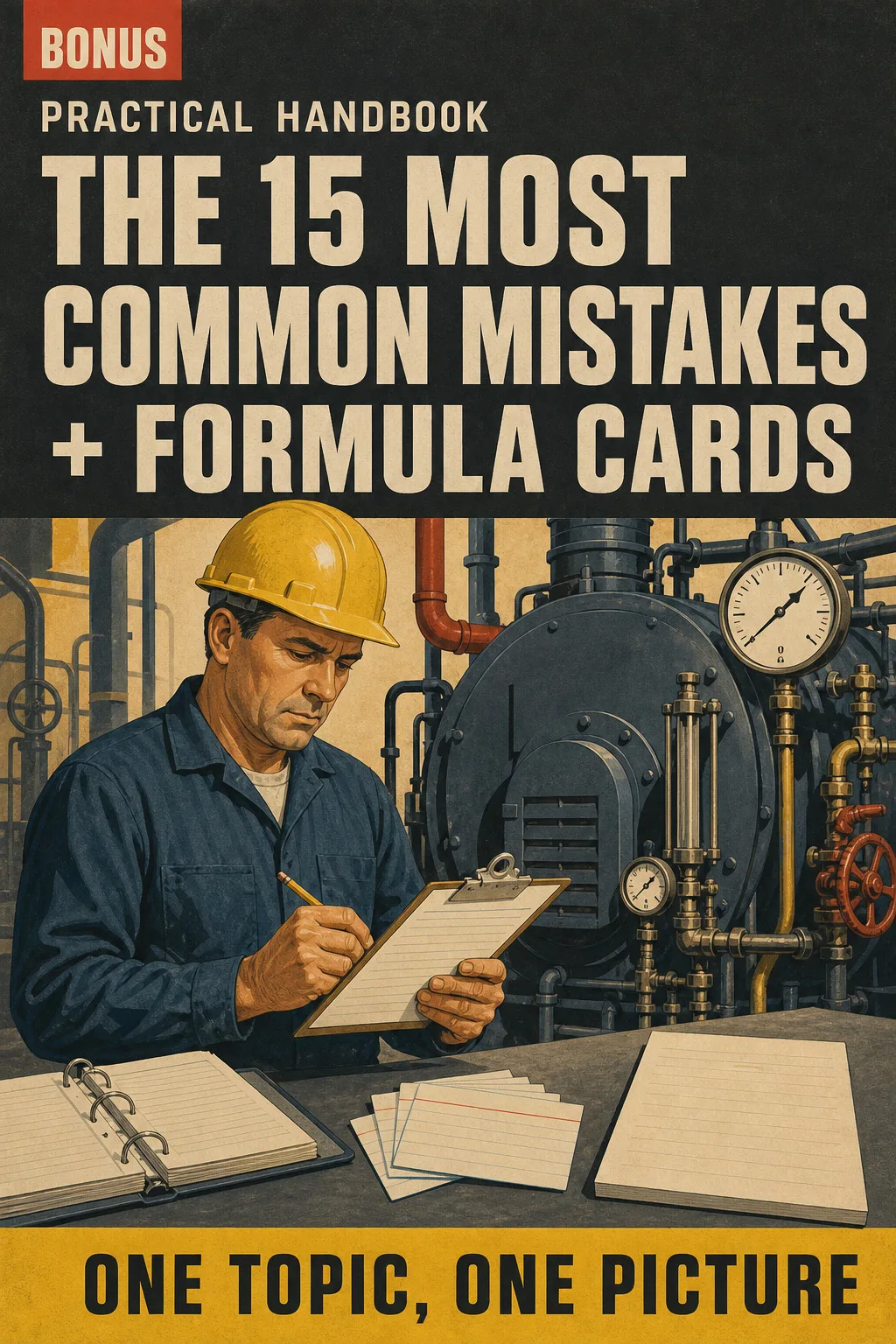
The 15 Most Common Mistakes + Formula Cards

BONUS 2: «The 15 Most Common Mistakes + Formula Cards»

Value on its own: US$ 14.90

See the slip-ups operators make most often, drawn before/after, plus the key formulas and units on cards you can print and keep at hand.

2nd Class Power Engineer Illustrated with 2 Free Books

  • 2nd Class Power Engineer Illustrated: 66 illustrated pagesUS$ 63
  • BONUS 1: 2nd Class Practice Questions: Multiple Choice and Long-Answer, with Worked AnswersUS$ 17.90
  • BONUS 2: The 15 Most Common Mistakes + Formula CardsUS$ 14.90
  • High-resolution PDF to printIncluded
Total value US$ 95.80
YOUR PRICE:
US$ 27
You save US$ 68.80
YES, I WANT 2ND CLASS POWER ENGINEER ILLUSTRATED FOR US$ 27

📄 This is a digital PDF book sent to your email: nothing is printed or shipped.

Secure purchaseEncrypted payment30-day guarantee

PDF by email: We email you 2nd Class Power Engineer Illustrated as a PDF, together with the two free books. It's a single payment: no installments, no extra charges.

Who This Book Is For

You're starting the 2nd Class syllabus

You're starting the 2nd Class syllabus

See the whole syllabus drawn and in order, and know where each topic fits before you open the course texts.

Your exam date is coming up

Your exam date is coming up

Review one topic per page between rounds and run every calculation the same way: data, sketch, calculate, conclude.

You already run a plant on shift

You already run a plant on shift

Keep the drawings at hand to check why the plant does what it does, from the safety valve to the condenser vacuum.

Everything You Get Today

US$ 95.80US$ 27
YES, I WANT 2ND CLASS POWER ENGINEER ILLUSTRATED FOR US$ 27

📄 This is a digital PDF book sent to your email: nothing is printed or shipped.

30DAYS
GUARANTEE

30-Day Guarantee

Try 2nd Class Power Engineer Illustrated for 30 days, bonus books included.

We refund everything if the file won't open, if the book isn't what you see here, if you were charged twice or if the email doesn't arrive. Just email us.

You pay once. No subscriptions.

Frequently Asked Questions

Is it for me if I already have my 3rd Class and work rotating shifts?

Yes. It's made for operators who know the plant and want the 2nd Class syllabus drawn and in order, one topic per page. It goes past 3rd Class basics: steam tables, combustion, Rankine efficiency and velocity diagrams.

Where does the content come from?

From the standardized 2nd Class Power Engineer syllabus, cross-checked with the CSA B51 code and the requirements of ABSA, TSSA, TSASK and Technical Safety BC. Steam table values are rounded from standard published steam tables; on exam day, use the tables your exam provides.

Is this official material?

No. It's an independent study book, not affiliated with or endorsed by SOPEEC, CSA Group, ABSA, TSSA, TSASK or Technical Safety BC. Check the current exam format with your provincial authority.

Does it replace my course or the course texts?

No. It's the drawn map for reviewing and understanding what the course texts say. It doesn't give a certificate or count toward your qualifying time: those still come from your course, your plant and your provincial authority.

Are the practice questions the ones on the exam?

No. They're written for this book, in exam style, with worked answers. They aren't official questions from any exam.

When and how does it arrive?

As a PDF by email, at the address you enter at checkout, together with the 2 bonus books. It's a one-time payment, not a subscription.

Does it work for my province, or only for Ontario?

It follows the standardized 2nd Class syllabus used across the provinces, in SI units, and names the regulators for Alberta, Ontario, Saskatchewan and BC. The exam format (multiple choice or long-answer), pass mark and qualifying time are set by your provincial authority: check them there before you book your exam.

Can I have it on paper?

Yes. The PDF prints at home or at a print shop, so you can keep it in your locker at the plant.

How does the refund work?

You have 30 days. We refund everything if the file won't open, if the book isn't what you see on this page, if you were charged twice or if the email doesn't arrive: just email us.

Before You Close This Page

No more rereading a chapter that won't stick.

Hoop stress, hfg and the Rankine cycle: you see them drawn, and that's it.

You walk into the exam knowing where everything is.

Drawings make studying faster.

The book is right below.

One-time payment: US$ 27 · Guarantee: 30 days · PDF by email

YES, I WANT 2ND CLASS POWER ENGINEER ILLUSTRATED FOR US$ 27

📄 This is a digital PDF book sent to your email: nothing is printed or shipped.